
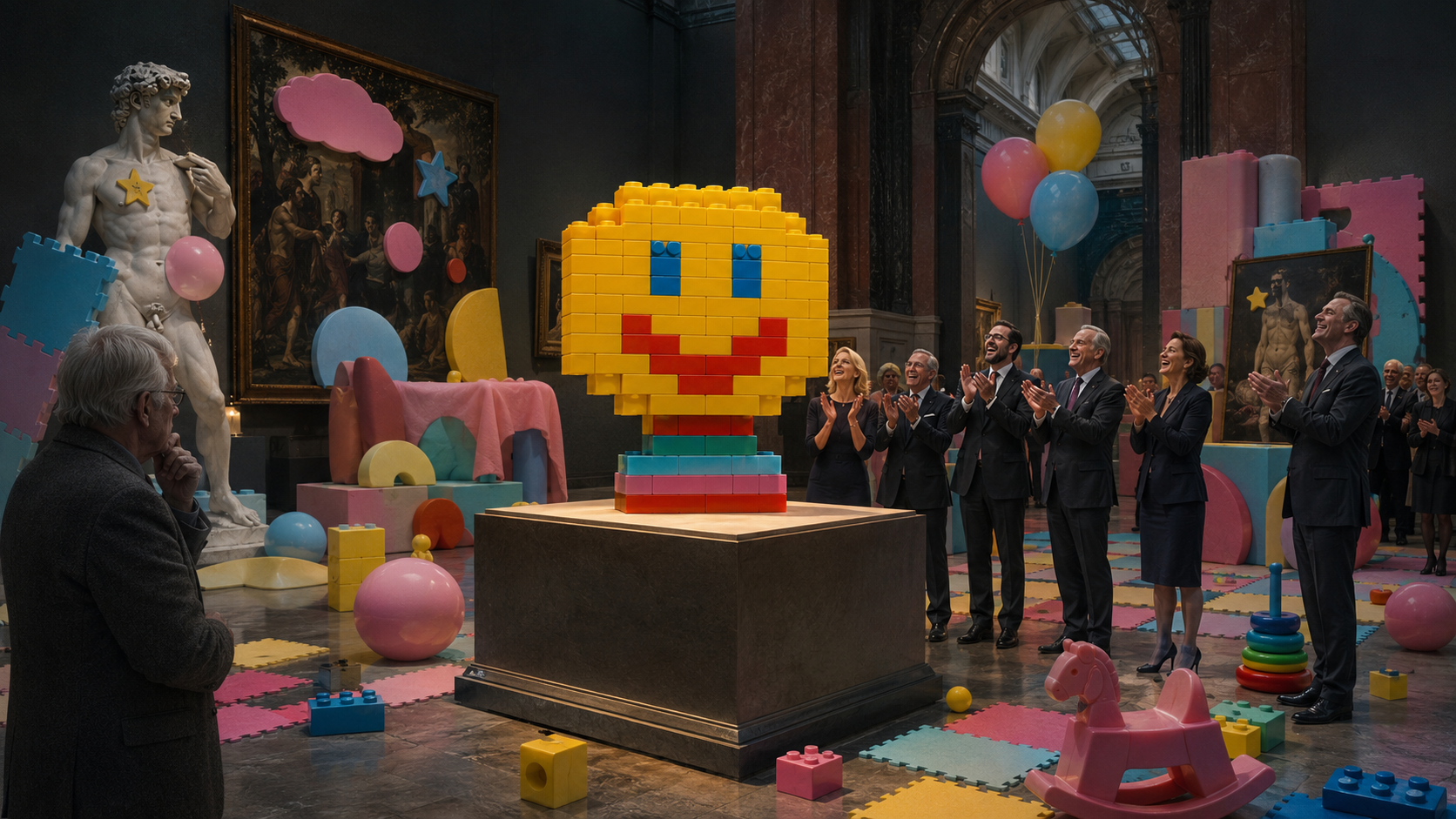
The infantilization of art and culture begins with opinion leaders who believe they are experts on everything.
From this self-proclaimed position of authority, they constantly sit in judgment on artists and audiences alike.
What is presented as social responsibility thus threatens to result in paternalism, self-censorship and, ultimately, the destruction of genuinely independent art.
This creates a climate in which risks are avoided and experimentation is discouraged. Artists feel compelled to screen their work for possible criticism before the public has even had the opportunity to form its own judgment. The result is an impoverished cultural landscape in which safe, predictable choices prevail.
Moreover, attention shifts away from the intrinsic value of art towards the question of whether it is sufficiently “correct” or “responsible” according to prevailing standards. Art consequently loses its ability to unsettle, provoke and open up new perspectives. Yet these are precisely the qualities that make art essential to a vibrant and critical society.
Art in the Straitjacket of Subsidies
Subsidies can give artists the freedom to create work that would stand little chance in the commercial market. But when public funding develops into a culture with its own rules, fashions and moral conditions, support gradually turns into control. The artist then receives not only money, but also an invisible manual specifying which subjects matter, which words should be used and which social message is considered desirable.
To obtain funding, artists are increasingly required to adapt to policy documents, fashionable themes and measurable objectives. A work of art must not merely be good or original; it must also be inclusive, sustainable, accessible, innovative, unifying and socially relevant. This may sound admirable, but the danger is that art becomes little more than a tidy checklist of policy goals. Free experimentation disappears behind application forms, project proposals and carefully worded promises.
This creates an art world in which it is not necessarily the most unconventional artist who is rewarded, but the one who has mastered the language of funding applications. Artists learn to anticipate: What does the committee want to hear? Which subject is currently popular? Which wording will increase the likelihood of approval? Before the artwork even exists, it is already being adapted to the presumed tastes of administrators and assessors. Self-censorship then becomes not an order imposed from above, but a survival strategy.
This culture also encourages safe mediocrity. Understandably, committees tend to favour projects that appear professional, socially responsible and low-risk. Work that genuinely unsettles, offends, confuses or fails is difficult to defend in an annual report. Yet it is precisely the unpredictable, uncomfortable and sometimes unsuccessful experiment that provides the breeding ground for art.
Art should not be an extension of government policy. It does not have to constantly improve, unite or educate society. Art may be pointless, contrarian, ugly, elitist, absurd, humorous or downright irritating. It must be able to ask questions that policymakers cannot answer and cross boundaries that committees would rather guard.
The answer is not necessarily to abolish subsidies. Without public support, many important forms of art would disappear or become entirely dependent on the market, sponsors and attendance figures. But funding should be based on trust and artistic freedom, with fewer ideological conditions, less bureaucracy and more room for risk and failure.
When artists primarily learn to meet the expectations of the system, art becomes predictable. The subsidy intended to liberate it then turns into a straitjacket. And art in a straitjacket may still be able to move, but it can no longer breathe freely.
Add comment
Comments