
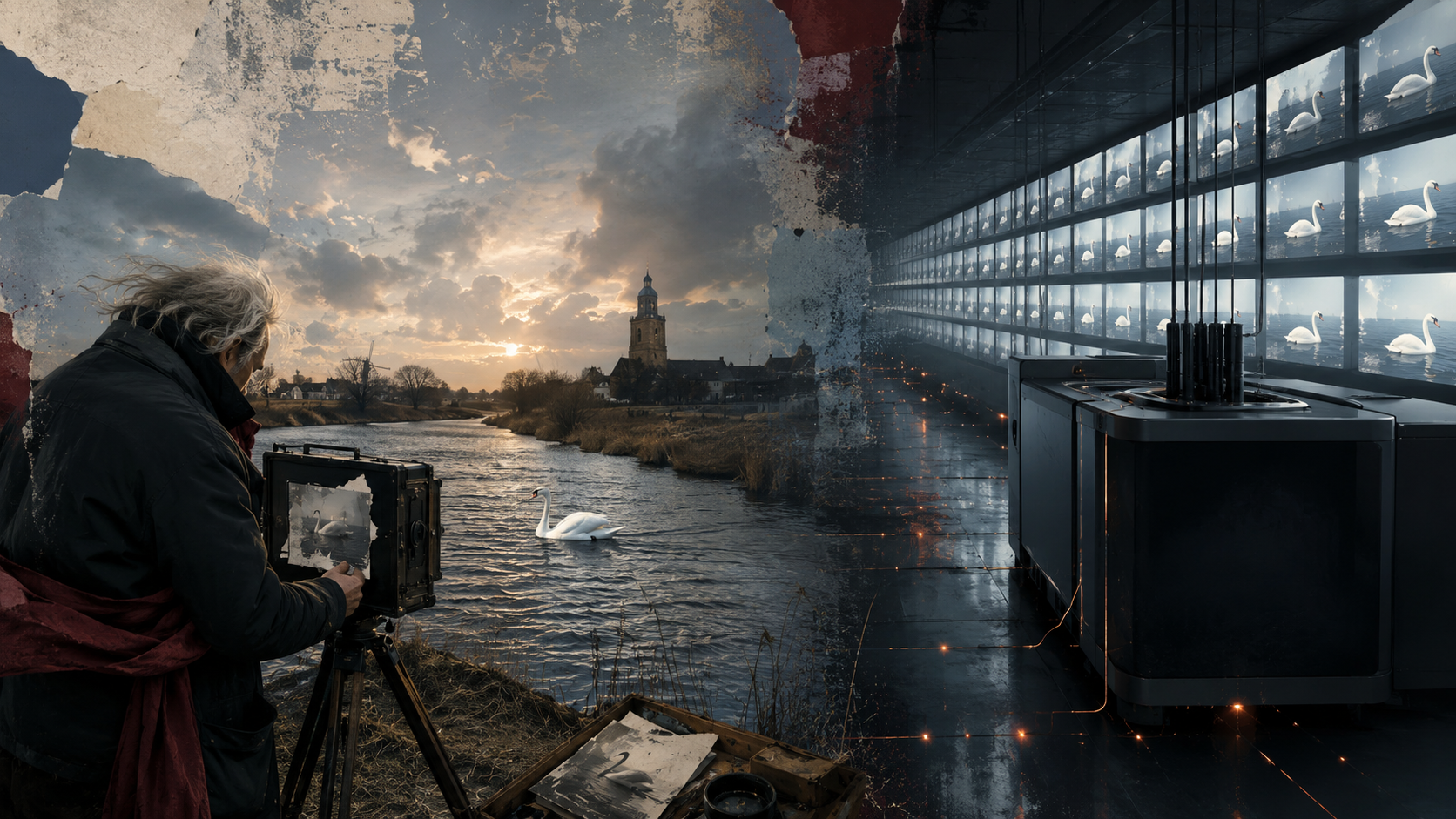
A.I. will radically change digital design, but it will not determine it completely.
It will primarily accelerate production; humans will remain responsible for vision, meaning, and selection. At the same time, I expect certification marks or labels for human-made art to emerge.
What will change in digital design?
Over the next five years, A.I. will become a standard component of virtually all design software. Designers will soon be able to produce images, typography, animations, websites, and complete visual identities within minutes. As a result, the profession will change:
- Technical production will become cheaper and faster.
- Concept, taste, and artistic direction will become more important.
- Designers will spend more time selecting, combining, and correcting.
- Small studios and individual artists will be able to create productions that once required an entire team.
- The volume of mediocre, similar-looking imagery will increase enormously.
The last point poses the greatest danger. A.I. learns from existing images and generally chooses what is recognizable and probable. Without strong human direction, this will result in a slick, flawless, but also predictable visual culture.
Will A.I. determine everything?
Economically, A.I. will acquire considerable power. Advertising agencies, publishers, and media companies will use it to cut costs. For standard illustrations, simple websites, product photography, and social media content, manual design will become increasingly difficult to justify.
Artistically, however, the situation is different. A.I. can imitate styles, but it has no childhood, memories, convictions, doubts, or personal sense of necessity. It can create an image of the Dokkumer Ee, but it has never stood there, felt the wind, or watched the light change. That human experience may therefore become valuable once again.
We will probably see two parallel worlds:
- A large commercial image industry in which A.I. is the standard production method.
- A smaller but highly valued market for demonstrably human, personal, and handcrafted work.
Compare this with photography after the invention of the smartphone. More photographs were taken than ever before, but exceptional photography did not disappear. It simply had to distinguish itself more clearly.
Will there be an A.I.-free certification label?
Probably, although initially it is more likely to be a voluntary certification mark than an official European label for art. Private initiatives such as “Not By AI” and certification services for human-made work already exist. None of them has yet become a universally recognized standard.
The European AI Act focuses primarily on making certain A.I.-generated or manipulated content identifiable. The transparency requirements in Article 50 apply from 2 August 2026. Among other things, they require machine-readable markings for generative systems and visible disclosures in certain cases, but they do not establish an official certification mark for A.I.-free art. European Commission: transparency of A.I.-generated content
Rather than a single certification mark, a system with three categories is more likely:
LabelMeaningHuman-madeConcept and execution without generative A.I.A.I.-assistedA human creator, with A.I. used only for technical or limited elementsA.I.-generatedThe image was largely produced by a generative model
Technologies such as Content Credentials can record which equipment and software were used to create a file and how it was subsequently edited. They function as a kind of digital ingredients label. C2PA on Content Credentials
An absolute label guaranteeing “no A.I. whatsoever” will be difficult to achieve. Modern cameras, smartphones, and image-editing programs already use machine learning for autofocus, noise reduction, masking, and colour correction. A credible certification system should therefore distinguish primarily between technical assistance and the generation of the artwork itself.
My expectation is that A.I. will become the industry standard, while demonstrably human-made work will acquire a special status—like analogue photography, hand-printed graphic art, or an original painting. Not because human-made work is always more beautiful, but because there is a real person behind it who has experienced, chosen, and intended something.
Add comment
Comments